


MVGRCE (A) Conducts Five-Day Online FDP on Quantum Machine Learning for Next-Generation Communication Systems
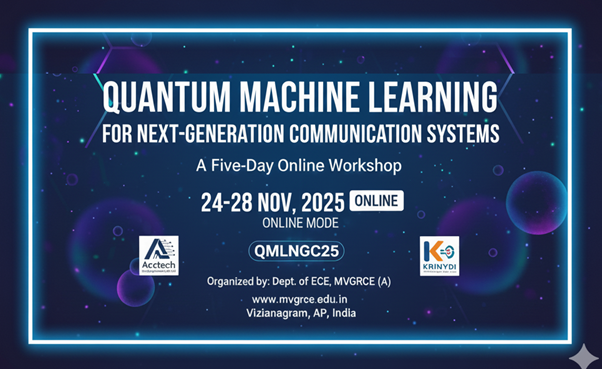
The Department of Electronics and Communication Engineering, MVGR College of Engineering (Autonomous), successfully organized a Five-Day Online Faculty Development Program (FDP) on “Quantum Machine Learning for Next-Generation Communication Systems” from 24th to 28th November 2025. The FDP was co-sponsored by Acctech Infosystems Pvt. Ltd. and Krinydi Technologies Pvt. Ltd.
With rapid advancements in quantum technologies and next-generation communication systems, the FDP aimed to provide faculty, researchers, and industry professionals with the foundational principles and latest developments in Quantum Computing, Quantum Machine Learning (QML), and their emerging applications in communication engineering.
A total of 129 participants registered for the program, and 83 qualified for certificates after successfully completing the FDP’s online assessment.
Objectives of the FDP
The program was designed to offer exposure to a wide spectrum of advanced topics, including:
- QML theory and applications
- QML for 6G communication security
- ML-based ECG signal processing
- QML for printed antennas
- Quantum optimization for spectrum resource allocation in wireless networks
- QML for IoT and edge computing
- Quantum communications and QML for autonomous mobile systems
About the FDP
Quantum computing represents a powerful computational paradigm that leverages the principles of quantum mechanics. Its potential impact spans multiple domains of engineering, especially communication systems, electromagnetics, and antenna technologies.
The sessions provided an intuitive introduction to quantum computation, highlighting its strengths, limitations, and transformative applications. Special focus was given to printed antennas, which play an essential role in quantum sensing and communication systems—particularly in areas such as NV-center-based quantum devices and next-generation terahertz and optical communication.
Participants also gained insights into emerging quantum antennas and their significance in enhancing sensing, communication, and propagation capabilities.
Session Highlights & Distinguished Speakers
The FDP featured eminent resource persons from leading academic and research institutions:
Day 1
- T. Shanmuganantham, Professor, Pondicherry Central University
Session: Quantum computing as a cutting-edge paradigm in next-generation communication systems. - B. T. Krishna, Professor, JNTU Kakinada
Session: Quantum computing from an ECE perspective.
Day 2
- Shrivishal Tripathi, Assoc. Professor, IIIT Naya Raipur
Session: QML for printed antennas. - Rajashri Mahapatra, Professor, IIIT Naya Raipur
Session: QML for 6G antennas.
Day 3
- Akash Kumar Pradhan, Assistant Professor, VIT Vellore
Session: Photonics platform for quantum key distribution and beyond. - K. H. K. Prasad, Assistant Professor, Aditya University
Session: Machine Learning models for ECG signal processing.
Day 4
- Javeed MD, Director, Krinydi Technologies
Session: Quantum IoT and Edge Computing.
Day 5
- K. Venkata Rao, Professor, NITTTR Kolkata
Session: Deep Learning Models for Image Processing. - V. Nagesh, Professor, MVGRCE(A)
Session: QML tools and fundamentals.
Coordination & Organizing Team
- Convener: D. Rama Devi, Professor & HOD, ECE
- Coordinator: M. Satyanarayana, Professor
- Co-coordinator: V. N. Lakshmana Kumar, Professor
The event was supported by a strong organizing committee comprising 23 faculty members from the Department of ECE.
Conclusion
The FDP witnessed enthusiastic participation from academicians, research scholars, and industry professionals across the country. Out of the 129 registered participants, 83 successfully cleared the assessment exam and received certificates.
The management congratulated all successful participants and appreciated the dedicated efforts of the conveners, coordinators, and organizing committee for conducting a high-quality program enriched with expert lectures from distinguished speakers across academia and industry.
The Department of ECE continues its commitment to empowering faculty and researchers with emerging technologies that shape the future of communication engineering and intelligent systems.
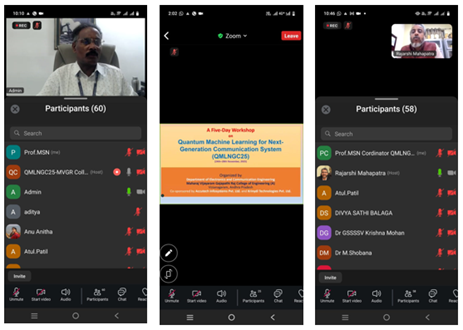
Press coverage:
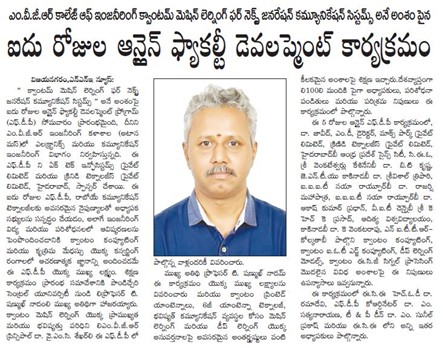
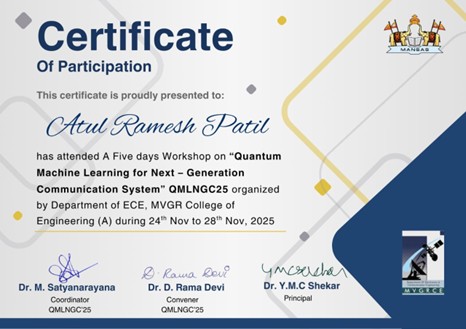
Sample Certificate of participation: